
Proof of Work for Freelancers: A More Trustworthy Alternative to Screenshots
Manual timesheets can't be verified and screenshot monitors invade privacy without adding context. Here's why a goal-scored, reasoned focus report is a stronger form of proof of work.

Every freelancer eventually hits the same wall: a client asks, "what did you actually do this week?" — and the honest answer lives only in your memory. You can write it down after the fact, which is a guess dressed up as a record. Or you can let a screenshot monitor watch your desktop all day, which is surveillance dressed up as evidence. Neither one tells the client what they actually want to know. They don't want to know you were "at your desk." They want to know the hours produced the outcome they're paying for, and why they should believe that without having to ask.
This is the trust gap almost every remote working relationship runs on, and it's been solved badly for a decade. The fix isn't more monitoring. It's a report that shows its reasoning.
The trust gap freelancers actually live with
Clients can't verify remote hours. They weren't in the room. They can't see the three false starts before the good idea, the twenty minutes spent reading documentation, or the Slack thread that ate an afternoon for a good reason. All they see is an invoice with a number on it.
Freelancers, meanwhile, can't prove they weren't slacking off without over-sharing — handing over a full desktop recording just to justify four billable hours feels like guilt by default, even when nothing questionable happened. So both sides default to trust, and trust without evidence is fragile. One bad week, one vague update, one slow-to-respond week, and the relationship's foundation gets shaky. Neither side is being unreasonable. The tools just haven't given them anything better to work with.
Why manual timesheets fail
A timesheet is a claim, not a record. There's no system generating it independently of the person being measured, which means there's nothing to verify against. It can be padded by ten minutes here and there without anyone noticing, and it can be perfectly honest and still look padded, because a client has no way to distinguish the two. The format doesn't fail because freelancers are untrustworthy — it fails because it was never designed to produce evidence, only a number.
Why screenshot monitors fail too — just differently
Tools like Time Doctor and Hubstaff solve the verification problem by capturing everything: periodic screenshots, active-window logs, sometimes keystroke counts. That produces a lot of data, but data isn't the same as an answer. A screenshot shows a screen, not a justification. A client scrolling through hundreds of blurred captures still has to guess whether each one represents real work — the tool just moved the guessing from "did they work" to "does this screenshot look like work."
It's also a trust problem in the other direction. Freelancers reasonably object to having their entire desktop recorded for a client relationship that might last one contract. It captures browser tabs that have nothing to do with the job, personal messages that happen to be open, anything visible on screen at the moment the capture fires. Nobody feels good handing that over, and plenty of good contractors will simply decline a gig that requires it.
What "context" actually means in a report
The piece both formats are missing is context: a stated goal, a relevance judgment against that goal, and a written reason for the judgment. Not "Chrome was open for 47 minutes" — but "spent 47 minutes in Chrome researching competitor pricing pages, which is relevant to the pricing-strategy deliverable this week."
That's the entire idea behind a reasoned focus report. Instead of capturing raw screen time and asking the client to interpret it, the system compares what was on screen to what the freelancer said they were working on, and writes down why each chunk of time counted or didn't. The output isn't a pile of screenshots. It's a short, structured explanation a client can actually read in under a minute.
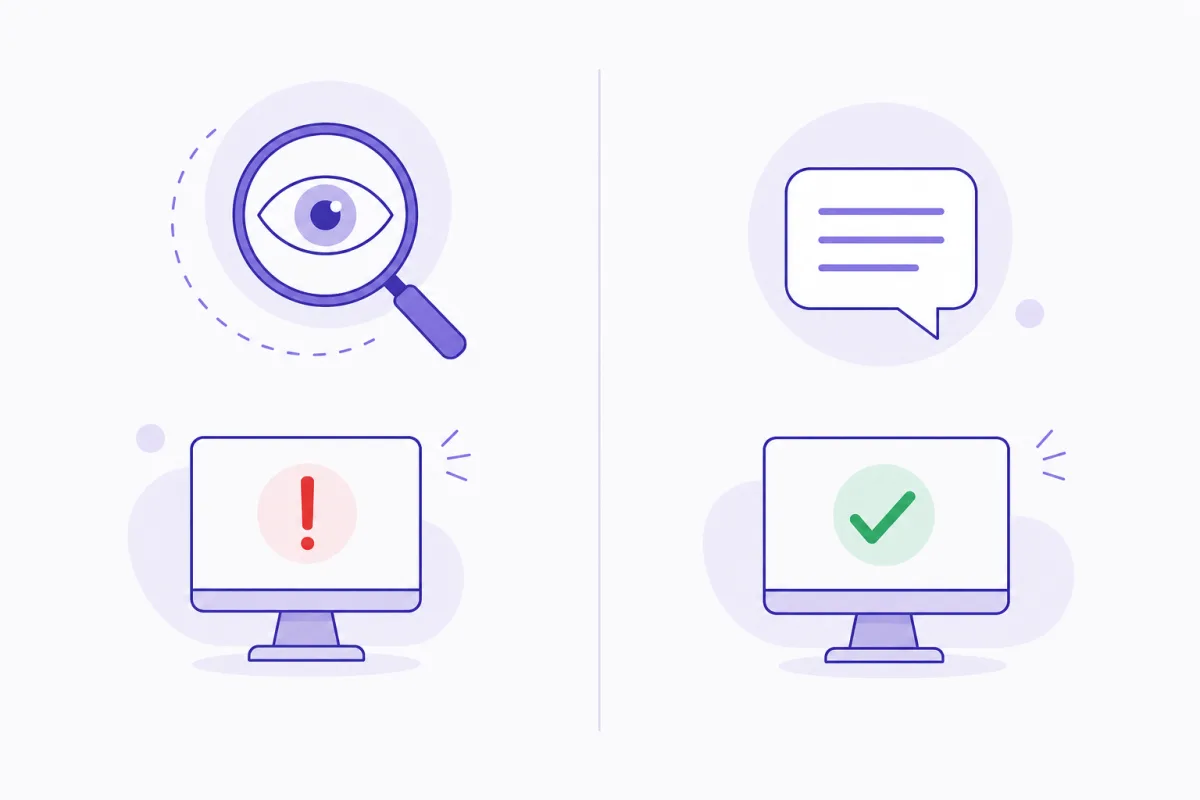 Same activity, two systems. One flags it. The other explains it.
A concrete example
Say a freelance developer spends twelve minutes on a competitor's app, poking around its UI. To a screenshot monitor, that reads as "off-task" — wrong app, wrong domain, nothing that looks like the client's codebase. Flag it, and now the freelancer has to explain themselves after the fact, in a message, defending twelve minutes out of a forty-hour week.
To a reasoned report, the same twelve minutes reads differently, because the report knows the stated goal for the week is "redesign the onboarding flow." Competitive research on how another product handles onboarding is directly relevant to that goal — so the entry gets logged as focused time, with a one-line reason attached: "Reviewing competitor onboarding UI patterns, relevant to the onboarding redesign goal." Same screen, same twelve minutes, completely different — and completely accurate — read.
Why this benefits the freelancer as much as the client
This isn't only a client-facing upgrade. It changes what a freelancer has to do at the end of a day. Instead of writing a status update from memory, or bracing for a "what were you doing at 2pm" question, the report already carries the explanation. You stop narrating your day defensively in a Slack message, because the report already did it — grounded in the goal you actually set, not a reconstructed memory of the day.
And critically, none of that required handing over raw screen recordings. The freelancer never had to choose between "prove it" and "give up their privacy" to get there.
Where FocusLens fits
This is the model FocusLens is built around: local capture on your Mac, AI relevance scoring against a focus goal you define yourself, and a shareable report that carries the reasoning instead of the raw footage. Nothing about a stated goal or a written reason is unique to any one tool — but it's the layer that's been missing from proof-of-work formats for years, and it's the layer that actually resolves the trust gap instead of just making it look busier.
The takeaway
The industry has spent a decade optimizing "proof of work" for surveillance — more data, less trust — instead of optimizing it for verification — less data, more context. A report that shows its reasoning is a better trade for both sides of a freelance relationship. The client gets something they can actually evaluate in a minute. The freelancer gets to stop justifying their day after the fact.
See it for yourself
Curious what a reasoned report actually looks like end to end? Walk through a real one in the sample focus report walkthrough, or jump straight to the report showcase on the homepage. When you're ready to generate your own, download FocusLens for Mac and set your first focus goal.
Ready to see it in your own work?
Download FocusLens and generate your first focus report.