
A Contractor Time Verification Guide for Agencies: Building Trust Without Screenshots
How small agencies and one-person shops can get credible time verification from contractors without deploying surveillance software — and what to ask for instead.
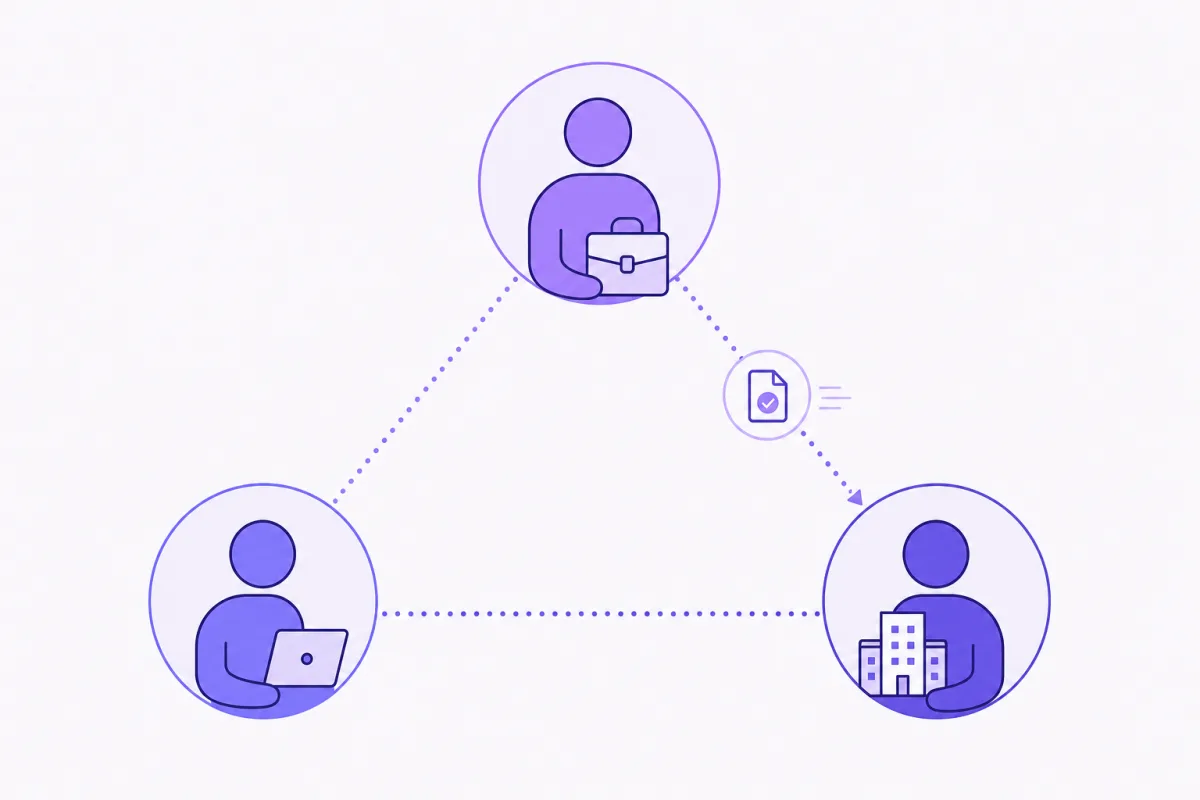
If you run a small agency, you're stuck in the middle. Your client wants proof the contracted hours were real. The contractor you hired doesn't want a monitoring agent recording their screen for a client they don't even work with directly. Most agencies solve this by picking a side: trust the invoice blindly and hope nothing ever gets disputed, or install something invasive and eat the hiring friction that comes with it. There's a third option, and it starts with asking contractors for a different kind of deliverable.
The specific problem an agency has
This isn't the same shape as the "solo freelancer vs. one client" trust problem. An agency sits between two relationships at once: the contractor doing the work, and the end client who's paying for it and never sees the contractor directly. Whatever verification an agency gets from a contractor has to be credible enough to hand off to a client who wasn't in the room for any of it — and it has to happen without the agency owner personally auditing every contractor's screen every week, because that doesn't scale past two or three people.
Why "just install Time Doctor on everyone" backfires
It's the obvious first move, and it causes three problems at once. Contractors push back — good contractors, the ones with options, are the most likely to decline a gig that requires full-desktop monitoring for a client relationship they're not even party to. It adds real hiring friction at exactly the stage where an agency wants candidates saying yes quickly. And there's a genuine legal and privacy exposure if a contractor works from a different jurisdiction than the agency assumes, especially once screen recordings of a contractor's personal accounts or other clients' work start getting captured incidentally.
But the part that matters most for trust: it still doesn't explain why the hours counted. The agency owner ends up scrolling through screenshots manually, trying to eyeball whether an hour looks legitimate — which is exactly the manual-review burden the monitoring software was supposed to remove.
What agencies should actually be asking contractors to produce
Not raw footage. A goal-scoped report, where the task or project itself is the stated goal, and the deliverable is a summary of time spent against that goal with a reason attached to each entry. Same basic idea as a timesheet — a document that says what happened during billable hours — except this version is generated from actual captured activity and scored against a real goal, instead of typed from memory at the end of the week.
This is the same shareable-report model covered in the proof-of-work explainer for freelancers, just applied one layer up: instead of a freelancer handing this to their one client, a contractor hands it to the agency, who then has something defensible to pass along.
How this fits an agency's existing workflow
In practice it slots in without much disruption. The contractor sets a focus goal scoped to the specific project or client they're billing — "redesign the client's checkout flow," say — and lets capture run through the work. At the end of the billing period, they generate a report for that goal, then either share the verified link or attach the exported PDF directly to whatever they send the agency. The agency owner reviews it once, then forwards the link or attaches the PDF to the client invoice — the same motion as attaching a timesheet, just with something behind it this time.
What the agency owner actually gets from this
A defensible, once-removed layer of evidence. If a client ever disputes a set of hours, the agency has something more substantial to point to than "the contractor told us this" — a report with a stated goal, a computed time breakdown, and a written reason per entry, generated independently of the invoice itself. And critically, the agency owner never had to become the one babysitting a contractor's screen to get there. The verification work happened between the contractor and their own activity log, not between the contractor and an agency-installed monitoring agent.
What this doesn't solve — said plainly
This is worth being honest about: it isn't fraud-proof against a contractor who's actually working a completely different set of hours than what got reported. No format that stops short of full-time surveillance can make that guarantee, and full-time surveillance carries its own costs, covered in the timesheets vs. AI focus reports comparison. What this is, is a large trust upgrade over an unverifiable timesheet — a report with a real goal, computed numbers, and stated reasoning beats a number typed into an invoice template, without requiring an agency to become a surveillance operator to get there. Set the expectation correctly with clients up front, and it holds up fine under scrutiny.
Rolling this out with contractors
Introduce it as an option for new contractors rather than mandating it retroactively across a roster that's already used to sending plain timesheets — that's a smoother conversation and avoids it landing as a trust downgrade for people who've never given you a reason to doubt them. Frame it to contractors as protecting their credibility, not policing them: it's the same report they'd want to have on hand if a client ever pushed back on an invoice anyway. A shared focus-criteria template per client or project type also helps — it keeps goal statements consistent across contractors, so the reports read comparably when they land on a client's desk.
The actual question to ask
The right question for an agency isn't "how do we watch our contractors more closely." It's "how do we get evidence credible enough to hand to our client, without becoming a surveillance operator ourselves in the process." A reasoned report is built for exactly that hand-off point — not for catching anyone, but for giving everyone something real to point to when a client asks the obvious question.
Get started
Try FocusLens with your next contract — download it for Mac and set up a shared focus-criteria template with your contractors. If you're the one being asked to verify your hours rather than the one asking, the freelancer-facing version of this pitch covers the same idea from your side of the relationship.
Ready to see it in your own work?
Download FocusLens and generate your first focus report.